
- Home
- About Us
- Divisions
- Adolescent and Young Adult Medicine
- Allergy and Immunology
- Cardiology
- Child Advocacy
- Emergency Medicine
- Endocrinology
- Gastroenterology, Hepatology and Nutrition
- General Academic Pediatrics
- Genetic and Genomic Medicine
- Health Informatics
- Pediatric Hematology, Oncology, and Stem Cell Transplantation
- Infectious Diseases
- Nephrology
- Neurology and Child Development
- Newborn Medicine
- Paul C. Gaffney Division of Pediatric Hospital Medicine
- Pulmonology
- Rheumatology
- Centers & Institutes
- Center for Pediatric Research in Obesity and Metabolism
- Center for Rare Disease Therapy
- Children's Center for Neurogenomics
- Children's Neuroscience Institute
- Cystic Fibrosis Research Center
- Institute for Infection, Inflammation, and Immunity in Children
- Pediatric Asthma Center
- Richard King Mellon Foundation Institute for Pediatric Research
- Pittsburgh Vaccine Trials Unit
- The Pittsburgh Study
- CHAMP: Career Help Advancement and Achievement Mentorship Program
- The Genetics, Genomics, and Growth Center
- Faculty Development
- Engagement
- Research
- Education
- Residencies
- Fellowships
- Continuing Medical Education
- Medical Student Education and Training
- Principal Investigator Labs
- Maintenance of Certification Portfolio Program
- Summer Research Internship
- Kidney Workshop (SRIP-Kid)
- Cardiology, Hematology, and Pulmonology (CHP) Summer Research Internship Program (CHP2SRIP)
- Hematoloy-Oncology (Hem/Onc)
- Endocrinology, Diabetes & Metabolism (Endo)
- Neurology, Child Development & Neuroscience (Neuro)
- Genetics & Genomic Medicine (GGM)
- Adolescent and Young Adult Medicine & General Academic Pediatrics (AMP)
- Infectious Diseases, Allergy & Immunology (IDAI)
- Directory
- Physician Scientist Training Programs
- News
- People
- Podcasts
Chiba Lab

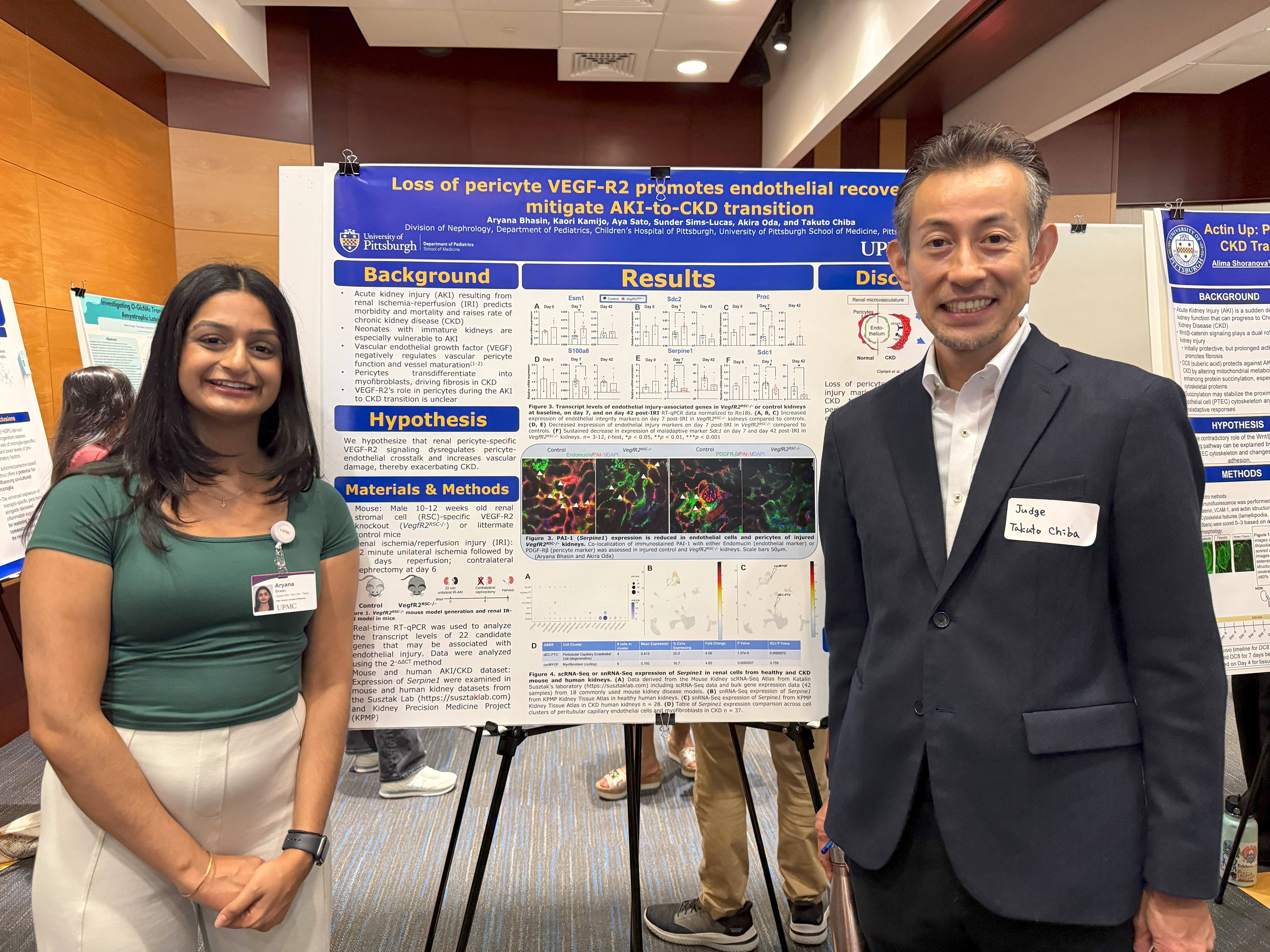 Aryana Bhasin and Takuto Chiba at the Summer Research Internship Program (SRIP) Poster Day in July 2025. Aryana was selected as one of the 10 Best Poster Award winners.
Acute damage to an organ often has lasting effects, contributing to the development of chronic disease. In nephrology, patients with acute kidney injury (AKI)—a sudden decline in kidney function—can sometimes recover through intrinsic repair mechanisms. However, over time, their kidney function may gradually deteriorate, leading to chronic kidney disease (CKD). CKD is a growing public health burden that results in significant morbidity and increased mortality risk.
During the AKI to CKD transition, kidney damage often fails to fully heal, resulting in a gradual decline in kidney function. This progression is typically marked by persistent inflammation, fibrosis (scarring), and impaired renal tubular and microvascular repair. Currently, there are limited therapies available to slow or prevent the progressive loss of renal function in CKD, often leading to the need for dialysis or kidney transplantation. This highlights the urgent need for novel therapeutic strategies to enhance renal repair and reduce the progression of renal fibrosis.
The Chiba laboratory is focused on understanding the role of the renal microvasculature in the transition from AKI to CKD. Specifically, we are investigating the role of vascular endothelial growth factor receptor 2 (VEGF-R2) signaling in vascular pericytes, a type of cell that surrounds microvascular endothelial cells. While VEGF-R2 is a potent angiogenic factor for endothelial cells, it can act maladaptively as a negative regulator in pericytes for microvascular injury. The lab is using genetic mouse models and exploring pericyte-specific therapeutics to make an impact on patients with CKD.
Affiliated Faculty and Staff
- Takuto Chiba, PhD - Principal Investigator
-
Mariko Muto, MD - Visiting scholar
-
Yukiko Sakurahara, BS - Research Intern
- Ayako Sato, BS, MS - Research Technician
Lab Members
Visiting scholars
- Akira Oda, MD/PhD (2023-2026)
- Yuko Hidaka, MD (2025)
- Kaori Kamijo, MD (2025)
Research Interns
- Aryana Bhasin (2025)
- Alejandro Romero (2024)
Representative Publications
Oda A, Malta Cerqueira D, Kinoshita A, Ho J, Sims-Lucas S, Chiba T. Mouse Model of Acute to Chronic Kidney Disease Transition Induced by Renal Ischemia/Reperfusion Injury. J Vis Exp. 2026 Feb 10;(228). doi: 10.3791/69866. PMID: 41770733
Chiba T, Oda A, Zhang Y, Bons J, Bharathi SS, Pfister KE, Zhang BB, Richert AC, Schilling B, Goetzman ES, Sims-Lucas S. Loss of long-chain acyl-CoA dehydrogenase protects against acute kidney injury. JCI Insight. 2025 Feb 11;10(6):e186073. doi: 10.1172/jci.insight.186073. PMID: 39932791
Chiba T, Cerqueira DM, Li Y, Bodnar AJ, Mukherjee E, Pfister K, Phua YL, Shaikh K, Sanders BT, Hemker SL, Pagano PJ, Wu YL, Ho J, Sims-Lucas S. Endothelial-Derived miR-17∼92 Promotes Angiogenesis to Protect against Renal Ischemia-Reperfusion Injury. J Am Soc Nephrol. 2021 Mar;32(3):553-562. PMID: 33514560
Chiba T, Peasley KD, Cargill KR, Maringer KV, Bharathi SS, Mukherjee E, Zhang Y, Holtz A, Basisty N, Yagobian SD, Schilling B, Goetzman ES, Sims-Lucas S. Sirtuin 5 Regulates Proximal Tubule Fatty Acid Oxidation to Protect against AKI. J Am Soc Nephrol. 2019 Dec;30(12):2384-2398. PMID: 31575700
Chiba T, Hukriede N, de Caestecker MP. Kidney Regeneration: Lessons from Development. Curr Pathobiol Rep. 2015 Mar;3(1):67-79. doi: 10.1007/s40139-015-0069-z. PMID: 26120499
Chiba T, Skrypnyk NI, Skvarca LB, Penchev R, Zhang KX, Rochon ER, Fall JL, Paueksakon P, Yang H, Alford CE, Roman BL, Zhang MZ, Harris R, Hukriede NA, de Caestecker MP. Retinoic Acid Signaling Coordinates Macrophage-Dependent Injury and Repair after AKI. J Am Soc Nephrol. 2016 Feb;27(2):495-508. PMID: 26109319
An ongoing list of current publications from the Chiba Lab.
https://pubmed.ncbi.nlm.nih.gov/?term=takuto+chiba&sort=date